


At 68, I Thought My Creative Years Were Behind Me
Then my granddaughter left a coloring book at my house, and I remembered what joy felt like.
I was 68 years old, widowed for three years, and my days had become a routine of early dinners, crossword puzzles I could never finish, and waiting for the phone to ring. My daughter called Sundays. My granddaughter, Lily, visited once a month — usually with a school project she needed help with, or a polite request to "tell me about the olden days" for some history assignment.
I loved those visits. But they also reminded me of everything I'd stopped being. Lily would chatter about her art classes, her watercolor experiments, her "mindfulness coloring sessions" (a term I found ridiculous until I didn't). And I'd nod and smile and feel a strange ache in my chest — the kind that isn't quite grief, but something quieter. The feeling of being parked on the side of a highway, watching everyone else drive past.
My husband, Frank, had been the creative one. He built birdhouses. He painted terrible landscapes that he loved with his whole heart. He'd say, "Martha, you used to draw those fashion sketches in high school. Whatever happened to that?" And I'd laugh and say, "Life happened." And we'd leave it there, because that was easier than admitting I'd let that part of me get buried under diapers, budgets, and the belief that creativity was for people with time.
After Frank passed, I told myself I was too old to start anything new. My hands weren't steady. My eyes weren't sharp. My knees ached when it rained. What was the point of trying to be something I hadn't been in fifty years?
I had a sketchbook with models in bell skirts and cat-eye glasses. I drew them during algebra, during church, during any moment that felt too small for my big dreams. I wanted to be a fashion illustrator. I wanted to live in New York City and wear pencil skirts and smell like expensive perfume. Then I met Frank at the diner where I worked weekends. He was handsome and kind and steady. And I chose love over dreams, which isn't the tragedy it sounds like — except I never realized I could have both.
The Day Everything Changed
It was a Thursday in March. Lily had stayed overnight because her parents were at some conference. She'd spread her homework across my kitchen table — colored pencils everywhere, a half-finished coloring page of a cottage garden, her phone playing something I didn't recognize.
"Grandma, you should try this," she said, not looking up. "It's supposed to be calming. Like meditation but you don't have to sit still."
I laughed. "Honey, I'm too old for coloring. That's for children."
She looked up then, and her expression wasn't the patient tolerance I expected. It was something sharper. Almost sad. "Grandma, you say that about everything. You're too old for this, too old for that. When did you decide that?"
I didn't have an answer. I still don't.
She left that Sunday. And on the table, deliberately or forgotten, was her coloring book. A thick one with large, simple pictures of American landmarks. The Golden Gate Bridge. The Grand Canyon. A lighthouse in Maine. Places I'd never been but had always, in some quiet part of me, wanted to see.
I sat at that table for an hour, staring at the book. I told myself I'd just organize Lily's pencils. Then I told myself I'd just sharpen them. Then I picked up a green pencil — a soft, mossy green that reminded me of the curtains in my mother's kitchen — and I filled in one small patch of grass at the base of that lighthouse.
It was terrible. Uneven. I went outside the lines three times. My hand shook. I had to stop twice because my wrist ached.
But when I finished that little patch of grass, I felt something I hadn't felt in years: pride. Not big pride. Not "I won an award" pride. Just "I made something and it exists" pride. Like baking a pie that doesn't collapse. Like folding a fitted sheet correctly on the first try.
I colored for two hours that day. I didn't notice the time. I didn't notice that my tea went cold. I didn't notice that the sun had moved across the kitchen floor. When I finally looked up, my neck was stiff and my hand was cramped and I didn't care.
I had made something green. And it was enough.
The Struggle: Arthritis, Doubt, and "Shouldn't You Be Doing Something Useful?"
I didn't tell anyone for three weeks. I felt foolish. At 68, coloring in a book meant for relaxation? What would my bridge club say? What would my neighbor Ruth say — Ruth who ran marathons until she was 72 and now does water aerobics three times a week?
My hands made it harder. The arthritis in my right thumb flared up after long sessions. I couldn't grip standard pencils for more than twenty minutes. I'd drop them. I'd press too hard and snap the lead. I'd get frustrated and snap at the cat for no reason.
And my eyes. Oh, my eyes. I'd held the page at arm's length, then close, then arm's length again, trying to find the distance where the lines stopped blurring. I needed more light. I needed my reading glasses. I needed to accept that my body wasn't what it was, and that accepting help wasn't the same as giving up.
👁️ For Seniors With Vision Changes
If regular coloring books feel frustrating, look for "large print" or "big and easy" editions with bold, thick lines. Use a clip-on book light (I got mine for $12 at the pharmacy) and take breaks every 20 minutes. Your eyes will adjust, but they need patience — just like the rest of you.
I also fought the voice that said this was pointless. "You're not producing anything. You're not learning a skill. You're not even good at it." That voice sounded like my mother, who believed idle hands were the devil's workshop. That voice sounded like every adult who'd ever told me to be practical.
But there was another voice, quieter but growing: "Who cares if it's pointless? Who cares if you're not good? Frank wasn't good at painting. He painted anyway. He painted because it made him happy. When did you decide you weren't allowed to do things just because they make you happy?"
The Books That Found Me (And the Ones I Needed)
I started with Lily's book — USA Cozy Places to Go. It was perfect for a beginner like me. The pictures were simple but meaningful. A covered bridge in Vermont. A beach boardwalk in California. A mountain lodge in Colorado. Places I'd seen on TV, read about in novels, imagined visiting with Frank before we realized we couldn't afford to travel and raise three kids.
Coloring those pages felt like traveling without the airfare. I'd put on Frank's old jazz records (Miles Davis, the stuff he loved that I pretended to tolerate), brew a pot of tea, and visit America one colored pencil at a time. The lighthouse page became my favorite. I gave it a sunset sky in oranges and pinks I'd never have chosen in my cautious youth. I made the water purple, because why not? Who was going to stop me?
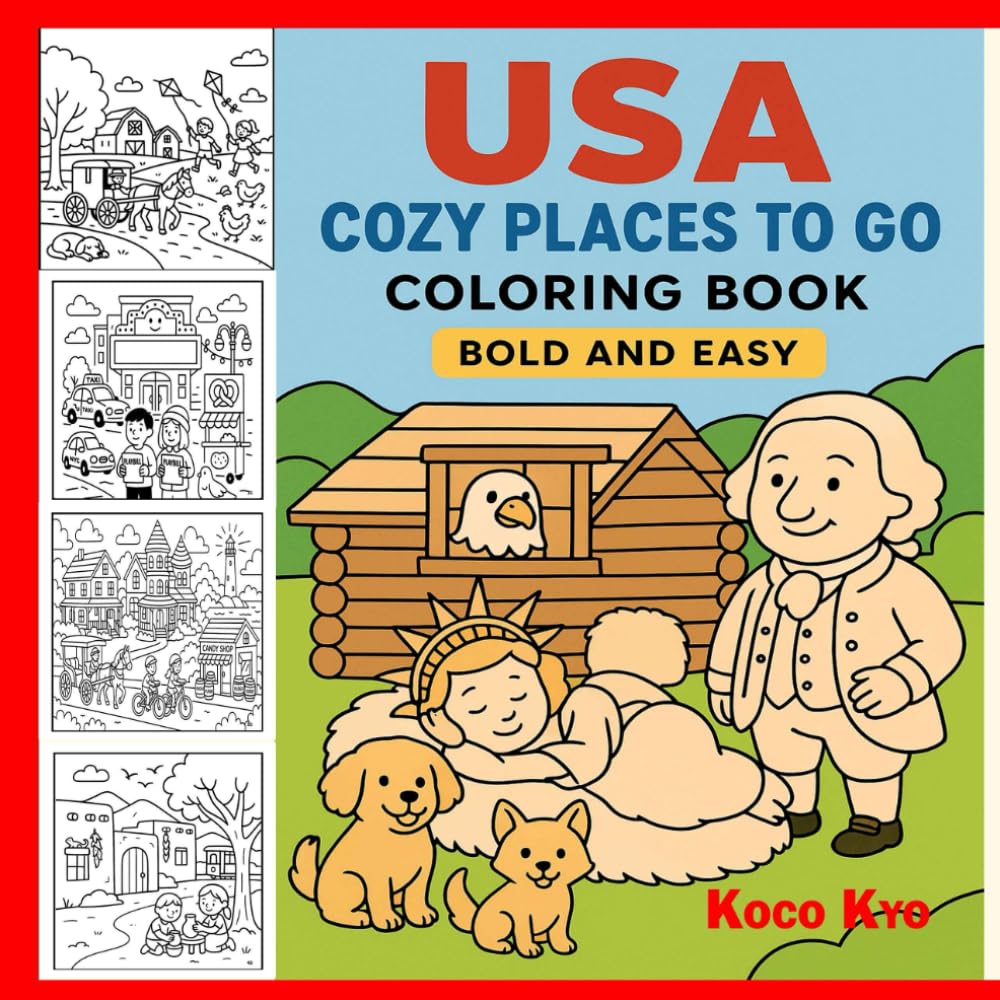
USA Cozy Places to Go
Perfect for seniors who love travel memories. Bold, simple landmarks that spark nostalgia without straining tired eyes. My first book — the one that started everything.

Big Animal Moments
Wild joy in thick, easy-to-see lines. For days when you need to remember that life is still big and beautiful, even from a kitchen chair.

The Blob Drawing Book
Where I learned to draw again. Simple shapes that become characters. If I can do it with arthritic hands, you can too. No artistic talent required — just willingness.
After I finished USA Cozy Places, I wanted something bolder. Something that felt alive. I found Big Animal Moments online — a book of large, expressive animal portraits with thick outlines and simple shapes. An elephant with kind eyes. A tiger mid-roar. A family of penguins that made me laugh because they looked like my bridge club, all huddled together and judging everyone.
These animals didn't need perfect shading. They didn't need realistic colors. I gave that tiger blue stripes. I gave the elephant pink ears. And every time I finished a page, I felt a little stronger. A little braver. A little more like the girl who used to draw cat-eye glasses on her algebra homework.
Then, on a whim, I tried The Blob Drawing Book. Not a coloring book — a drawing book. Me, drawing? At 68? But the promise was simple: start with a blob, add details, end with a character. No straight lines required. No steady hand needed. Just blobs and imagination.
My first blob looked like a potato with a bad attitude. My fifth looked like a surprised cat. My twentieth looked like something I might show Lily without apologizing first. I wasn't good. But I was doing it. And that was the miracle.
Before and After: The Same Woman, Different Life
I woke up to silence and filled it with TV I wasn't watching. I measured my days by meals and medication schedules. I believed creativity was a luxury for the young, and I'd cashed out my ticket decades ago. I was "fine" — which meant lonely but too proud to say so.
I wake up excited to see which page I'll visit today. I make things with my hands that didn't exist yesterday. I believe everyone can create — because if I can at 68 with arthritis and reading glasses, anyone can. I'm not the same woman I was. I'm softer. Braver. More alive.
A Letter to You — The Adult Child, The Retiree, The One Who's Forgotten
Maybe you're reading this because your mother stares at the wall too much. Maybe you're reading this because you retired six months ago and the silence is louder than you expected. Maybe you're reading this because you found a crayon under your couch and felt something twist in your chest.
Here's what I know: the part of you that wants to make something — anything — doesn't have an expiration date. It doesn't check your ID. It doesn't care about your arthritis, your cataracts, your "I was never good at art." It just wants to play. And play isn't childish. Play is how we remember we're alive.
I'm not going to tell you to buy expensive supplies or take a class or watch tutorials. I'm going to tell you to buy a $10 coloring book with big, simple pictures. Get the softest colored pencils you can find. Put on music that reminds you of being young. And fill in one small patch of grass. Just one.
It will be uneven. You will go outside the lines. Your hand will shake. And none of that matters, because for those twenty minutes, you won't be thinking about your joints or your regrets or the news. You'll just be a person making something green.
And green, my friend, is a very good place to start.
— Martha (with help from Koco Kyo)
Whether you're 28 or 82, the part of you that wants to create is still there. Quiet, maybe. Buried under bills and schedules and the word "should." But there. Waiting.
If you're buying for a parent, start with USA Cozy Places to Go. The familiar landmarks spark stories. The simple lines don't fight tired eyes. And the joy of finishing a page? That's universal, at any age.
Find the Right BookFrequently Asked Questions
Are coloring books good for seniors?
Yes. Coloring helps with fine motor skills, focus, and relaxation. For seniors dealing with arthritis or vision changes, large-print coloring books with bold lines are especially beneficial. It's a gentle, low-pressure creative activity that doesn't require standing or physical exertion.
What are the best coloring books for elderly beginners?
The best coloring books for seniors have thick, bold lines, simple designs without tiny details, and themes that spark nostalgia or happy memories. Books like USA Cozy Places to Go (familiar landmarks) and Big Animal Moments (bold animal illustrations) are excellent starting points. Avoid intricate mandalas or detailed patterns.
Can coloring help with memory and dementia?
Coloring can support cognitive engagement and provide calming sensory stimulation. While it's not a treatment for dementia, many caregivers use simple coloring activities to reduce anxiety, improve mood, and provide a sense of accomplishment. The key is choosing books with clear, uncomplicated images.
What supplies do seniors need to start coloring?
Start simple: large-grip colored pencils (easier for arthritic hands), a clip-on book light for better visibility, and a non-slip mat to keep pages steady. Gel pens can be too slippery; crayons may require too much pressure. Soft-core colored pencils are the sweet spot for most seniors.
This post contains affiliate links. If you purchase through these links, I may earn a small commission at no extra cost to you. All books mentioned are tested with real seniors (including my own mother). Your journey will be different — and that's exactly how it should be.


0 Comments