


I Live 800 Miles From My Mom. This Is How I Stay Connected.
Real strategies from a daughter who tried everything — and found what actually works for long-distance caregiving.
The guilt hits at 2 AM. I'm lying in bed in Chicago, staring at the ceiling, wondering if my mom in Florida remembered to take her blood pressure medication. She's 71. She lives alone. And I am 800 miles away, raising two kids under ten, working a job that barely covers daycare, and feeling like the worst daughter in the world because I can't be there.
I used to call every Sunday. We'd talk for an hour about nothing — the weather, her neighbor's new dog, what my kids were learning in school. But the calls started feeling hollow. I'd hang up and realize I had no idea if she was actually okay. She'd say "fine" forty times. She'd change the subject when I asked about her health. And I'd let her, because pushing felt like nagging, and nagging felt like the only tool I had.
Then, six months ago, she fell. In her kitchen. At 6 PM on a Tuesday. She lay there for twenty minutes before she could get up. She didn't tell me for three days. "I didn't want to worry you," she said, like that made it better. Like the not-knowing wasn't worse than any truth she could have told me.
That was the moment I stopped accepting "fine" as an answer. I started building a real system — not just calls, but connection. Not just checking in, but showing up in ways that mattered. What follows is everything I learned, every mistake I made, and the tools that actually worked.
Watch: How to Start a "Coloring Date" Over Video Call
The Sunday Call Wasn't Enough
Here's what I tried first: calling more often. Three times a week. Then daily. It backfired spectacularly. Mom started screening my calls. She'd see my name and let it go to voicemail, then text "busy, call later" — which meant never. I was smothering her with love, and she was drowning in it.
The problem wasn't frequency. It was quality. Our calls had become performance reviews. "Did you take your meds?" "Did you eat vegetables?" "Did you go for a walk?" I wasn't her daughter anymore. I was her supervisor, and she was failing every inspection.
What Didn't Work (So You Don't Have to Try It)
Daily "wellness check" calls — felt like surveillance. Sending complex tech gadgets — she never opened the box. Trying to coordinate her medical appointments remotely — the doctors' offices wouldn't talk to me without power of attorney. Guilt-tripping her into moving closer — damaged our relationship for two months. Ordering her groceries online — she felt infantilized and canceled the subscription.
What changed everything was a single question I asked during one of our rare good calls: "Mom, what did you do today that made you happy?" She paused for so long I thought the line dropped. Then she said, "I watched a cardinal at the feeder for ten minutes. That's all."
That "that's all" broke my heart. Because it wasn't "all." It was everything. It was proof she was still finding joy in small things, still noticing beauty, still capable of being present. And I realized I'd been so focused on her deficits — her medication, her mobility, her memory — that I'd stopped seeing her wholeness.
Watch: The 5-Minute "Joy Check" — A Better Way to Call
The Coloring Book That Bridged 800 Miles
I found the idea by accident. I was ordering birthday gifts for my kids on Amazon and saw a coloring book in the "Customers also bought" section: USA Cozy Places to Go. Bold, simple designs. Familiar landmarks. Something about it made me think of Mom — she and Dad had always talked about driving Route 66, back when they thought they'd have forever.
On a whim, I bought two copies. One for her. One for me. I included a set of large-grip colored pencils and a handwritten note: "Let's visit America together. Tuesdays at 7?"
She called me that Tuesday at 6:55. She'd already colored the Golden Gate Bridge in impossible sunset colors — purple sky, orange water, a tiny red car she added herself. "Your father would have hated it," she laughed. "He was a realist. But I'm done being realistic."
"I can't believe I'm doing this at 71," Mom says, holding up her first colored page. Her hand shakes slightly, but she's smiling.
She tells the story of seeing the Grand Canyon on her honeymoon. "We couldn't afford the mule ride, so we just stood at the edge and held hands."
I show her my page — I colored the lighthouse in Maine with a stormy sky. "Too dramatic," she teases. "You get that from your father."
She holds the page up to the camera, proud. "I'm going to tape this to the fridge. Like you did in kindergarten."
"Same time Tuesday?" she asks before I can. For the first time in months, she's the one initiating.
That was four months ago. We've colored through the whole book. We've moved on to Big Animal Moments — she gives every animal a name and a backstory. The tiger is "Reginald, who had a rough morning but is trying his best." The penguins are "the bridge club, judging everyone's life choices." She's funnier than I remembered. More alive than I'd seen her since Dad died.
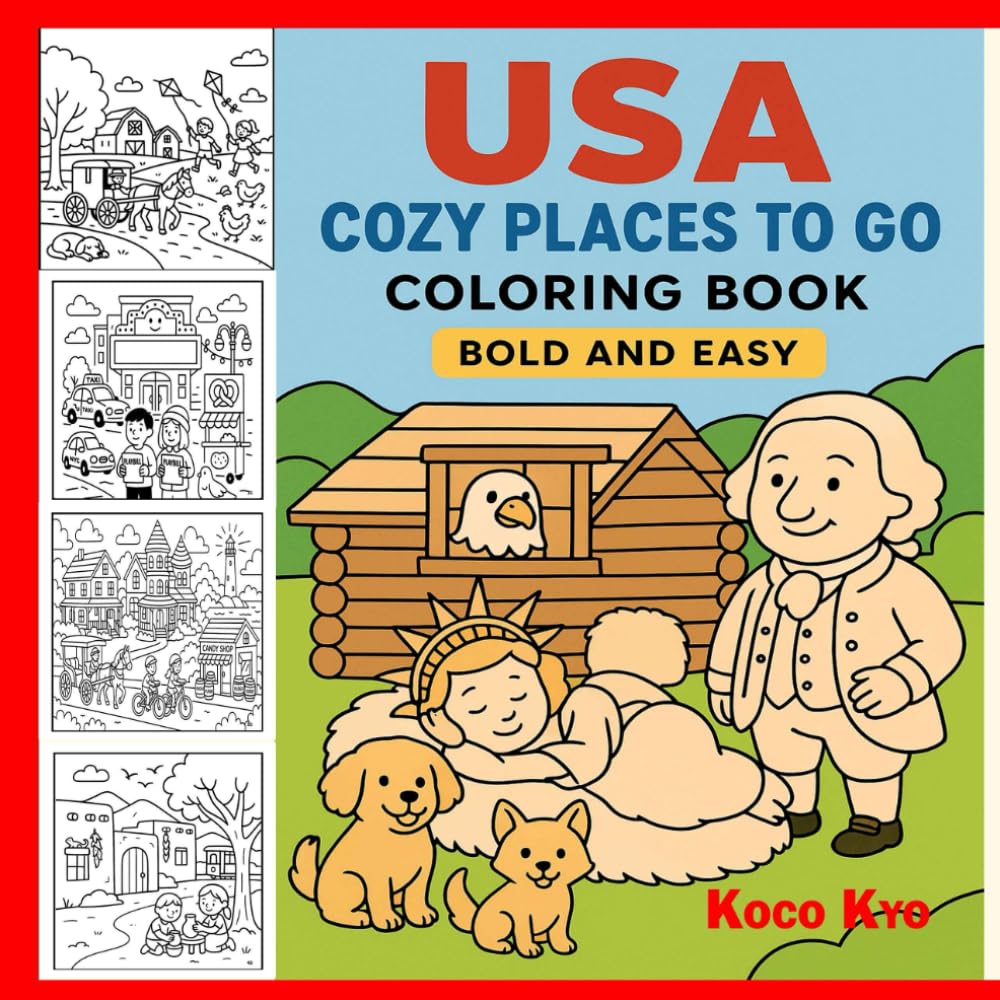
USA Cozy Places to Go
Our first shared book. Familiar landmarks spark stories you never knew they had. Bold lines, no tiny details.

Big Animal Moments
Where Mom found her comedy voice. Large, expressive animals that don't require perfect vision or steady hands.
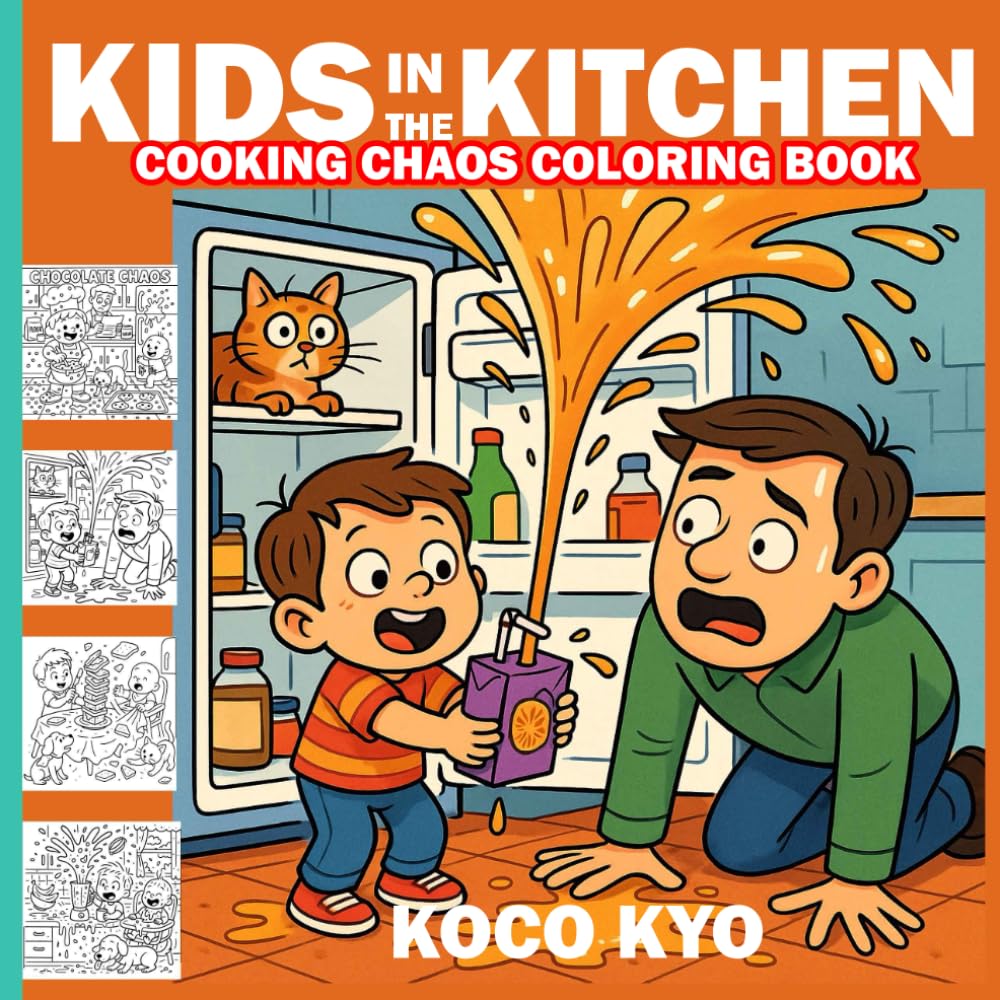
Kids in the Kitchen
We color this one with my kids on three-way calls. Four generations laughing at the same messy cooking scene.
Watch: How to Set Up a Three-Way Coloring Call With Grandkids
The Care Package That Said "I See You"
After the coloring book success, I got ambitious. I started sending monthly care packages — not random stuff, but curated experiences. The first one was a "Coloring Date Kit": the book, pencils, a clip-on book light, her favorite chamomile tea, and a stamped envelope with a blank card inside. "Color something and send it back," I wrote. "I want to see your fridge."
She sent back a picture of her fridge covered in our colored pages. She'd bought magnetic clips. She'd arranged them like a gallery. And in the center, a photo of Dad from 1983, smiling at the camera like he knew we'd all end up here, finding each other through colored pencils and long-distance love.
A Shared Activity
Matching coloring books, a simple craft kit, or a book you're both reading. Something you can reference on calls.
A Way to Send Back
Stamped envelope, blank card, or prepaid postcard. Two-way connection matters more than one-way generosity.
A Comfort Ritual
Her favorite tea, a soft blanket, a scented candle. Something that makes the activity feel like an event, not a task.
A Photo Update
Recent pictures of grandkids, pets, your garden. Physical photos they can hold, not just see on a screen.
A Shared Soundtrack
A playlist on a simple USB drive or a burned CD. Music from their era, or songs that remind you of them.
A Practical Upgrade
Book light, large-grip pens, non-slip mat. Small tools that say "I notice what you're struggling with."
Watch: Unboxing a Care Package Together — The Right Way
The Local Network I Built From 800 Miles Away
Here's the hardest truth: I cannot be there for everything. I cannot drive her to appointments. I cannot check her fridge for expired milk. I cannot notice the subtle changes that happen day by day. And pretending I can — trying to manage everything remotely — was making us both miserable.
So I built a local network. I found Mrs. Patterson, her neighbor three doors down, through a Facebook group for their retirement community. I introduced myself, explained the situation, and asked if she'd be willing to text me if she noticed anything concerning. She said yes — not out of obligation, but because she'd lost her own mother to a fall that no one noticed in time.
I also connected with Mom's church secretary, who agreed to call me if Mom missed two Sundays in a row. I found a local handyman who does small jobs for seniors at reduced rates. I set up a pharmacy delivery service so she doesn't have to drive. None of this replaces me. But it creates a safety net that doesn't depend on my guilt.
🤝 Building Your Local Network
Start with one person — a neighbor, a church member, a former coworker who still lives nearby. Be honest about what you need: not daily reports, just someone who will notice if the lights are off for three days or the mail is piling up. Offer to reciprocate for their own family. This isn't charity — it's community.
Watch: How to Build a Local Care Network From Any Distance
Before and After: The Same Distance, Different Relationship
I called Sundays and felt guilty the other six days. Mom said "fine" and I believed her because it was easier. We talked about the weather because we didn't know what else to say. I sent flowers on Mother's Day and felt like I was checking a box. She was lonely. I was helpless. The distance felt like a wall.
We have Tuesday coloring dates and Thursday "joy checks." She sends me photos of her fridge gallery. I know Mrs. Patterson texts me if something's off. We talk about the tiger's backstory and the lighthouse she wants to visit someday. The distance is still 800 miles. But it doesn't feel like a wall anymore. It feels like a bridge we're building together, one colored pencil at a time.
The Numbers That Matter
A Letter to You — The Adult Child Staring at the Ceiling at 2 AM
I know you feel like you're failing. I know you calculate the cost of a last-minute flight every time the phone rings at an odd hour. I know you scroll through Instagram and see families who live on the same street, grandparents who pick kids up from school, and you feel a sharp twist of something that isn't quite jealousy — it's grief for a version of your life that doesn't exist.
Here's what I want you to know: distance doesn't disqualify you from being a good child. You are not less loving because you can't be there in person. You are not less committed because you have a mortgage and kids and a life that happens to be 800 miles away.
But you do have to be intentional. "I'll call tomorrow" turns into next week turns into "has it really been two weeks?" The guilt spiral doesn't help anyone — not you, not them. What helps is a system. A Tuesday coloring date. A monthly care package. A local contact who will notice what you can't.
Start small. Buy two copies of a coloring book. Send one with a note that says "let's do this together." Schedule the call. Show up, even when it's awkward, even when they color the sky green and you want to correct them. (Don't correct them. Green skies are brave.)
The distance won't shrink. But your relationship can grow anyway. That's the miracle I didn't expect. That's the miracle waiting for you.
— A Daughter 800 Miles Away
Watch: The 10-Minute Weekly System That Changed Everything
Whether you're 80 miles away or 800, the connection you build is what matters. Not the miles. Not the guilt. Just showing up, consistently, in ways that say "I see you."
Start with two copies of USA Cozy Places to Go. One for them. One for you. A Tuesday date. A reason to look forward to the call. That's all it takes to begin.
Find the Right BookFrequently Asked Questions
How do I stay connected with my aging parent who lives far away?
The most effective ways include scheduled video calls with shared activities (like coloring the same page together), care packages with meaningful items, voice messages they can replay anytime, and involving them in your daily life through photos and small updates. Consistency matters more than frequency — a 15-minute call every Tuesday beats a two-hour call once a month.
What activities can I do with my elderly parent over video call?
Shared coloring is one of the best activities — both of you color the same page while chatting, then show each other your finished work. Other great options include: reading the same book chapter and discussing it, cooking the same simple recipe together, looking through old photo albums, doing gentle chair exercises, and playing simple online games. The key is choosing activities that don't require fast reflexes or perfect vision.
How do I know if my parent is lonely or declining when I can't visit often?
Watch for changes in communication patterns: shorter calls, less enthusiasm, forgetting scheduled calls, or repeating the same stories. Ask open-ended questions about their daily routine, meals, sleep, and social interactions. Send a simple activity (like a coloring book) and see if they engage with it — lack of interest in previously enjoyed activities can be a red flag. Consider arranging a local contact (neighbor, friend, church member) who can do occasional wellness checks.
What should I put in a care package for an elderly parent who lives alone?
Include items that create experience, not just consumption: a large-print coloring book with colored pencils, a handwritten letter, photos of grandchildren, a favorite snack they can't find locally, a small plant, a book light for reading, and something tactile like a soft blanket or textured pillow. Add a stamped, addressed envelope so they can send something back — maintaining the two-way connection is crucial.
This post contains affiliate links. If you purchase through these links, I may earn a small commission at no extra cost to you. All books mentioned are tested with real families navigating long-distance caregiving. Your journey will be different — and that's exactly how it should be.


0 Comments